
-
Recent Searches
Recent Searches
- My Account
- Customer Service
-
United States
 If you have any issues with booking online, please call customer services on (+44) 3333 000 128

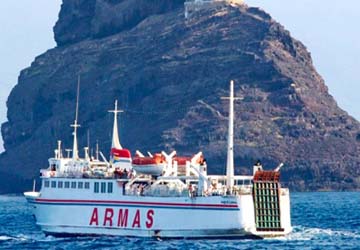
Ferry from Las Palmas (Gran Canaria) to Santa Cruz de Tenerife
| Las Palmas - Santa Cruz de Tenerife Route summary | |||||||||||||||||||||
|---|---|---|---|---|---|---|---|---|---|---|---|---|---|---|---|---|---|---|---|---|---|
| Departure Country | Spain | ||||||||||||||||||||
| Destination Country | Spain | ||||||||||||||||||||
| Operators | Naviera Armas | ||||||||||||||||||||
| Average Price | $222.0* | ||||||||||||||||||||
| Average Daily Sailings | 5 | ||||||||||||||||||||
| Average Weekly Sailings | 38 | ||||||||||||||||||||
| Average Sailing Duration | 1h 47m | ||||||||||||||||||||
| Fastest Sailing Duration | 1h 40m | ||||||||||||||||||||
| Distance | 53.1 nautical miles | ||||||||||||||||||||
*Prices subject to change, pricing taken from last 30 days, last updated 2023-03-06
The Gran Canaria to Tenerife ferry route is provided by 2 operators and is available for booking all year round. The ferry crossing from Gran Canaria to Tenerife takes approximately 1 hour and 40 minutes on ferries servicing this route. Gran Canaria to Tenerife ferry duration can range between 1 hour 40 minutes and 3 hours depending on the operator that you decide to travel with.
Las Palmas to Tenerife Ferry Schedules
There are around 43 ferry weekly sailings from Gran Canaria to Tenerife. Naviera Armas provide up to 6 sailings per day and Trasmediterranea provide just 1 sailing per week. Ferry timetables often increase during the high season.
The first ferry leaves at approximately 06:00 and the last ferry leaves at approximately 22:45.Ferry schedules can vary by operator and season.
High Speed Ferry Gran Canaria Tenerife
The fastest ferry from Gran Canaria to Tenerife is with Naviera Armas.
Can I reserve a cabin on the ferry from Las Palmas to Tenerife?
You can book cabins on ferries that sail from Las Palmas to Tenerife.
Gran Canaria to Tenerife Ferry Price
The price of a ferry from Las Palmas - Tenerife can vary between $33 and $390 depending on the operator, season and whether you are travelling with a vehicle. The average price of a foot passenger is $61, prices can range from $33 and $89. The average price with a car is $214. Car prices can range from $72 and $403. Prices may vary for other vehicle types. All ferry prices can change from season to season.
Prices subject to change, pricing representative of searches over last 30 days.
Cheap Ferry Tickets
Find cheap ferry tickets using our deal finder. It is highly recommended that you book in advance to ensure yourself the best possible prices and availability on the ferry Las Palmas de Gran Canaria Tenerife.
With 6 sailings per day, you are bound to find a suitable ferry crossing to suit your needs. However, there are an alternative ferry to Tenerife if you require additional flexibility.
Las Palmas - Santa Cruz de Tenerife Ferry Operators
-

- 6 Sailings Daily 1 hr 40 min
- Get price
Las Palmas Santa Cruz de Tenerife Average Prices
Prices shown represent the average one way price paid by our customers. The most common booking on the Las Palmas Santa Cruz de Tenerife route is a car and 2 passengers.
Las Palmas Guide
Las Palmas, officially named Las Palmas de Gran Canaria, is a city and capital on the Spanish island of Gran Canaria in the Canary islands. The city is roughly 150 km from the African coast and is located in the north east part of Gran Canaria. The city's climate, warm, dry summers and winters that aren't too cold, make it a popular destination for tourists.
The city was founded in 1478 by Juan Rejon and has many things to see and do including a selection of theatre, cinema, opera, music concerts, museums and galleries to enjoy. Two of the most popular cultural events held in the city are the Canary Island Music Festival and the International Film Festival. The most important historical buildings in the city can be found in the Vegueta part of the city where some of the buildings have been standing for 500 years. These include the Chapel of San Antonio Abad, the Plaza de Santa Ana which is bordered by the Casas Consistoriales, the Casa Regental, the Obispado and Santa Ana Cathedral.
Las Palmas is the main ferry port on the island. As the island is in the middle of the archipelago, Las Palmas ferry port provides connections to several islands (Fuerteventura, Lanzarote, La Palma, Tenerife) and also the south of Spain (Huelva and Cadiz).
Santa Cruz de Tenerife Guide
Santa Cruz de Tenerife is a port city located on the Spanish island of Tenerife, the largest of the Canary Islands. The city has an important port and is filled with wide streets, beautiful landscaped areas and some fine examples of modern architecture. The city can trace its back around 400 years when the city began to develop in the late 16th century aided by its port which enabled to city to become the second most populated city in the Canary Islands. The centre of the city sits on the site of the former fortress of San Cristobal and is looked over by the monument dedicated to the Triumph of Candelaria, which is a neoclassical sculpture in Carrara marble and was created by the Italian Pasquale Bocciardo. This part of the city is also overlooked by the 18th century Baroque facade of the La Carta Palace. In the centre of the city, near the sea, several of the busiest streets and squares of the capital meet, such as the Plaza de la Candelaria.
From the city's port there are ferry services departing to mainland Spain and to the other Canary Islands.